Four specialized agents collaborate with you across the research lifecycle — from document analysis to publication-ready insights, backed by formal mathematical validation and 80+ programmable tools.
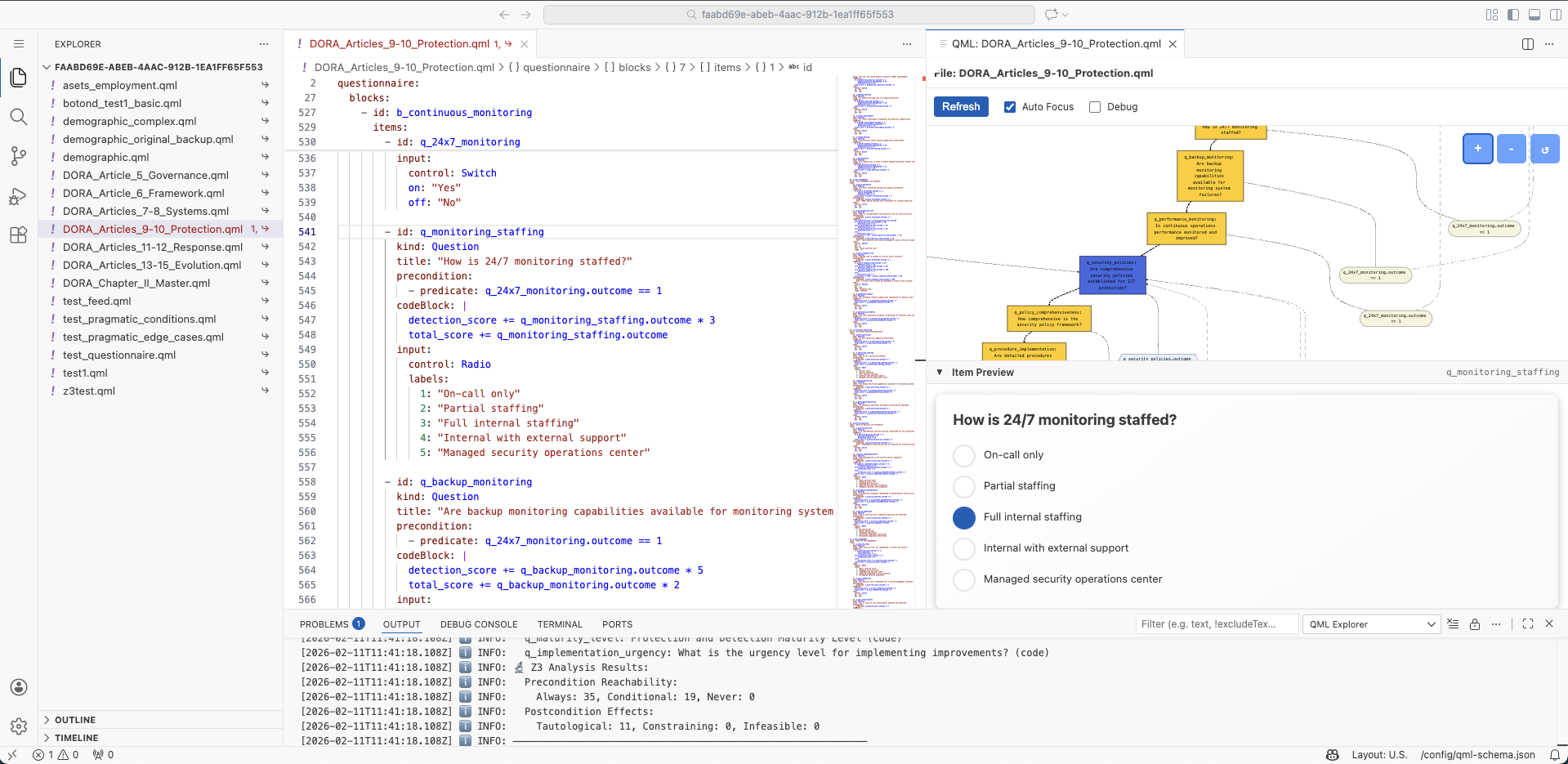
The Designer Agent operates in two distinct phases: first as a researcher analyzing your documents and extracting measurable concepts, then as a questionnaire architect generating mathematically validated QML. You control the transition.
Document analysis & concept extraction
Questionnaire design & formal verification
Both roles operate through the same chat interface in Armiger
In its research role, the Designer Agent ingests your source materials — research papers, compliance frameworks, clinical guidelines, policy documents — and produces a structured research document that captures all measurable concepts and their relationships.
Document Upload
PDF, Word, spreadsheets, regulations
Semantic Indexing
Chunked, embedded, stored in pgvector
Concept Extraction
Measurable dimensions, themes, scales
Research Document
Structured brief ready for your approval
# Generated by Designer Agent
questionnaire:
name: "Customer Satisfaction Survey"
items:
- id: overall_satisfaction
type: question
text: "How satisfied are you overall?"
control: likert_5
- id: dissatisfaction_reason
type: question
text: "What could we improve?"
control: open_text
precondition: "overall_satisfaction <= 2"
# SMT Validation: PASSED
# All items reachable
# All postconditions satisfiable
# No contradictions found
Z3 SMT Validation Passed
2 items verified · all reachable · 0 contradictions
In its generation role, the Designer Agent takes your approved research document and generates complete QML questionnaires with conditional logic, skip patterns, and appropriate response controls. Every questionnaire is then mathematically verified by the Z3 SMT solver.
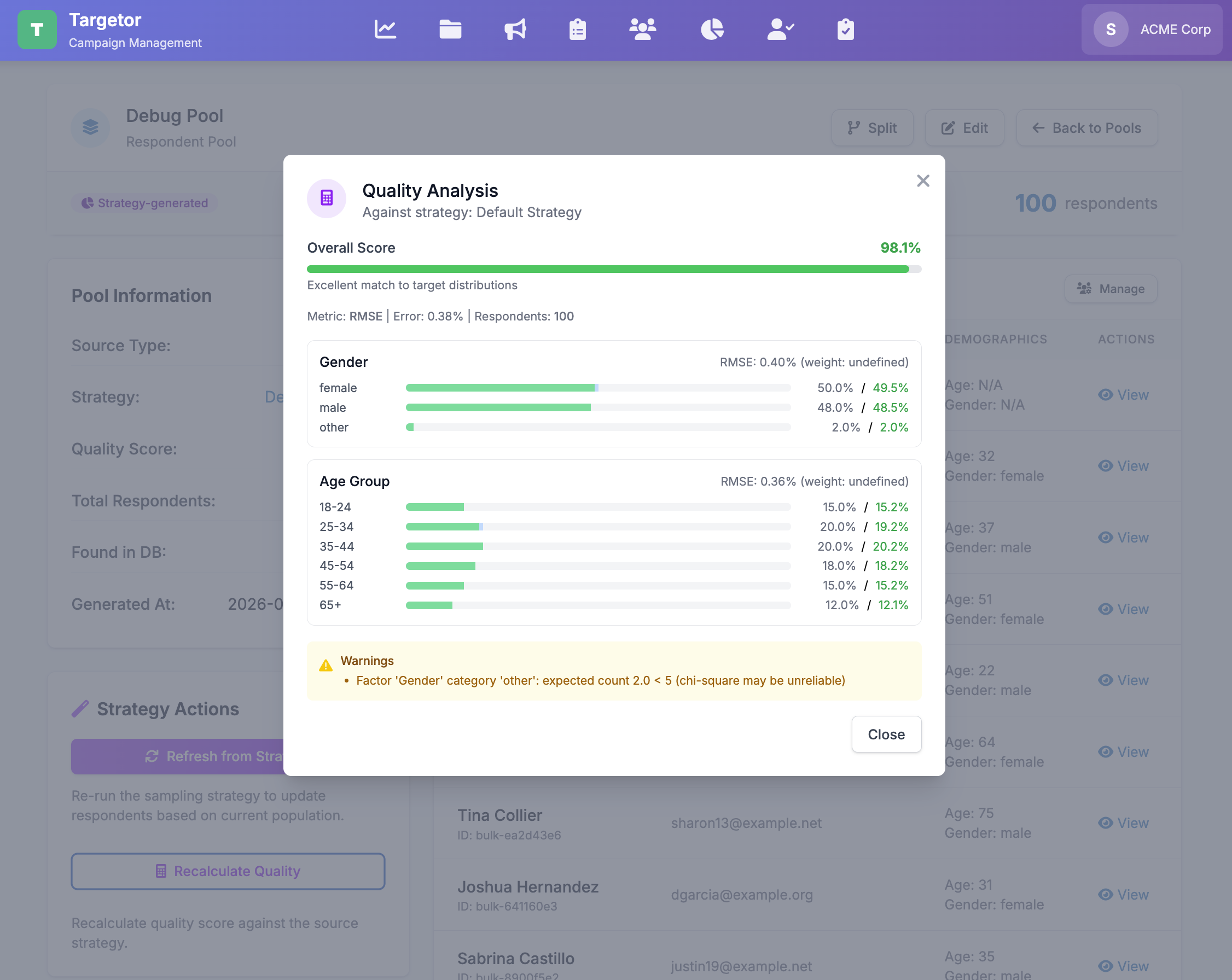
The Campaign Manager Agent guides you through campaign setup via two interfaces: a step-by-step wizard for beginners and a conversational chat for power users. It recommends sampling strategies, proposes demographic distributions, and warns about potential biases.
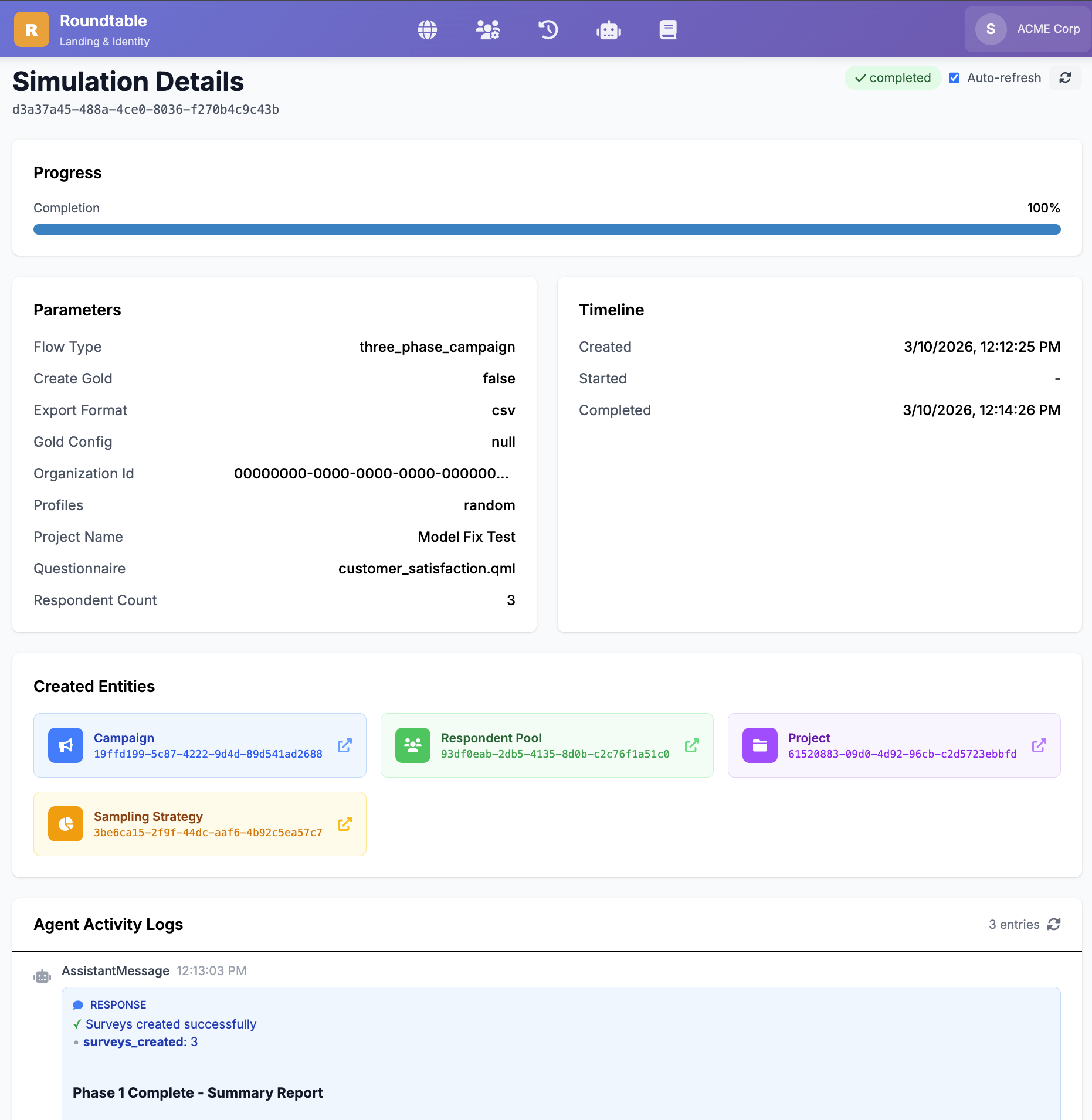
Respondent Agents adopt demographic personas and complete surveys with life-like responses — for testing questionnaire flow, validating analysis pipelines, or generating synthetic datasets. Three simulation modes cover every use case.
Single
One survey, one persona
Campaign
Full 3-phase lifecycle
Mass Fill
Bulk synthetic data
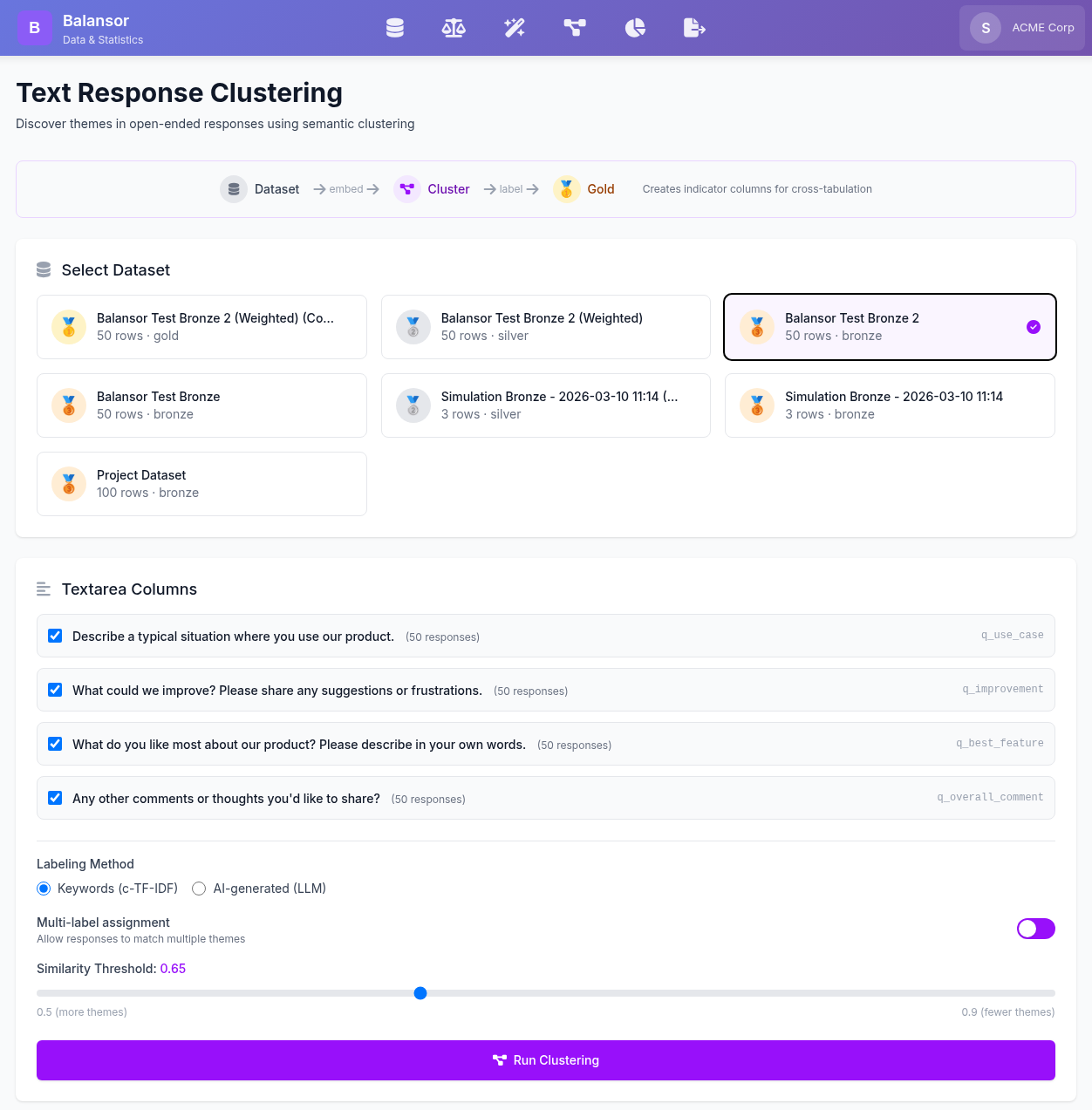
Semantic clustering turns free-text survey responses into structured, analyzable themes. Embeddings capture meaning — not just keywords — so similar ideas group together even when worded differently. Choose keyword extraction or AI-powered labeling to name each cluster.
No vendor lock-in. Use premium cloud models with your own API key, or use our free built-in local models at no cost. Switch providers anytime without changing your workflow.
Claude Sonnet, Claude Haiku
Default provider
GPT-4, GPT-4o
Ollama, Llama, Mistral
Free — hosted on our servers
Gemini Pro, Gemini Ultra
Every platform capability is accessible via REST API and Model Context Protocol (MCP). AI agents from any provider can manage your research autonomously through programmable tools.
// AI agent validates a questionnaire via MCP
validate_qml_file({
qml_name: "customer-satisfaction.qml"
})
// Then creates a campaign and generates a pool
create_campaign({
name: "Q1 National Survey",
project_id: "proj_abc123",
questionnaire_id: "qst_def456"
})
Specialized agents, mathematical validation, and 80+ programmable tools — from research documents to publication-ready data.