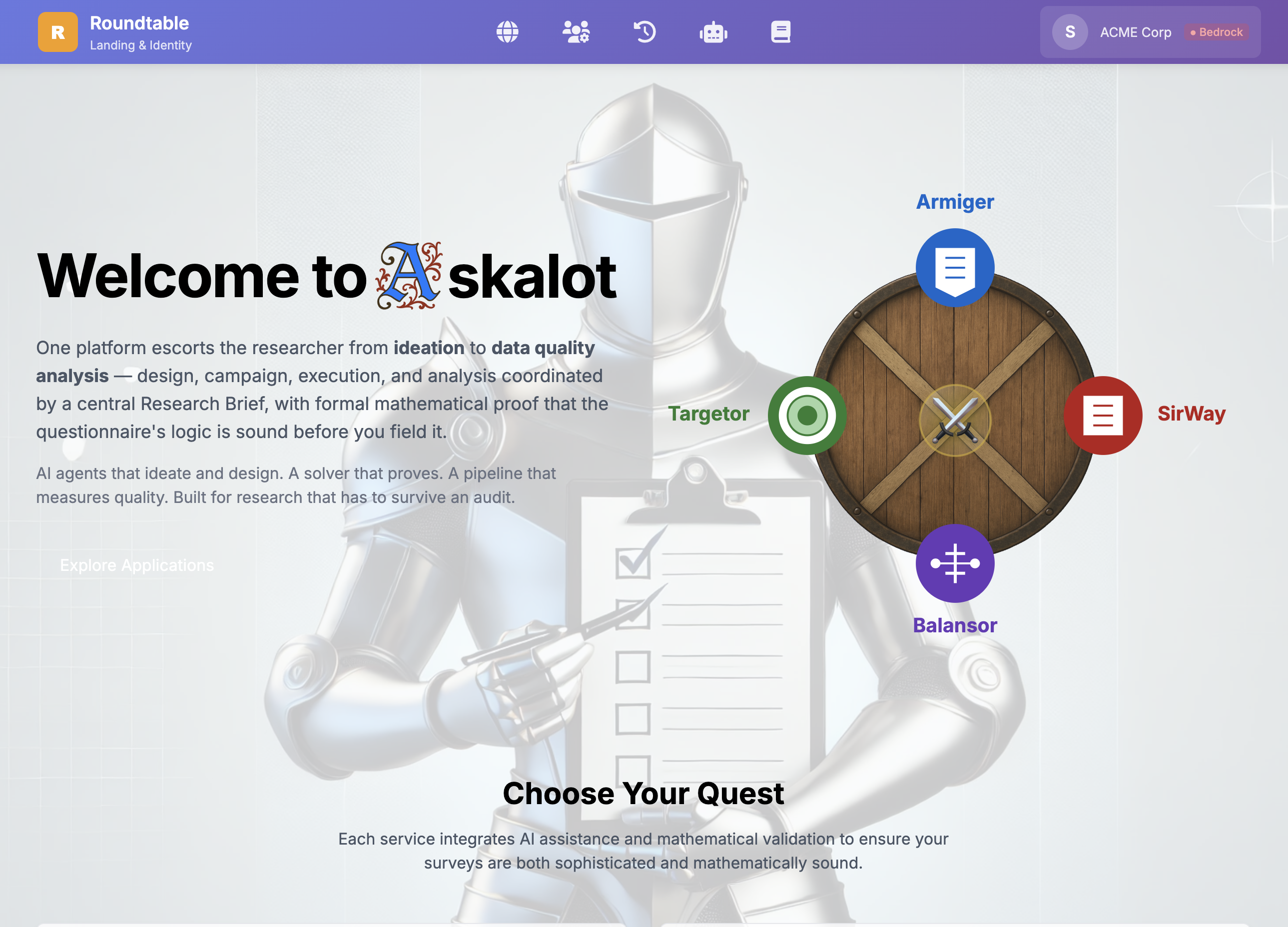
One platform escorts the researcher from ideation to data quality analysis — design, campaign, execution, and analysis coordinated by a central Research Brief, with formal mathematical proof that the questionnaire's logic is sound before you field it.
Four specialized AI agents work from a single, evolving Research Brief — the central source of truth for every project. Ideation, design, campaign, execution, and data quality analysis stay in lockstep, with formal mathematical proof that the questionnaire's logic is sound.
A central Research Brief is the source of truth for every project. Designer, Manager, Respondent, and Analyst all read from and write to the same brief, so ideation, design, campaign, execution, and analysis stay coherent end-to-end.
Z3 SMT solver formally proves questionnaire logic is sound — every question reachable, every path valid, every contradiction caught before deployment.
As a SaaS: our Designer, Manager, and Analyst agents are tuned with the Claude Agent SDK — Anthropic API or AWS Bedrock for IAM, VPC, and data-residency. As a tool: plug the 80+ MCP tools into your own agentic harness with any model.
Five stages, one Research Brief, zero gaps — the full research lifecycle in a single platform.
Ideate & Design
Turn a research question and source documents into a Research Brief, then into a QML questionnaire with mathematical proof of logical soundness.
Campaign
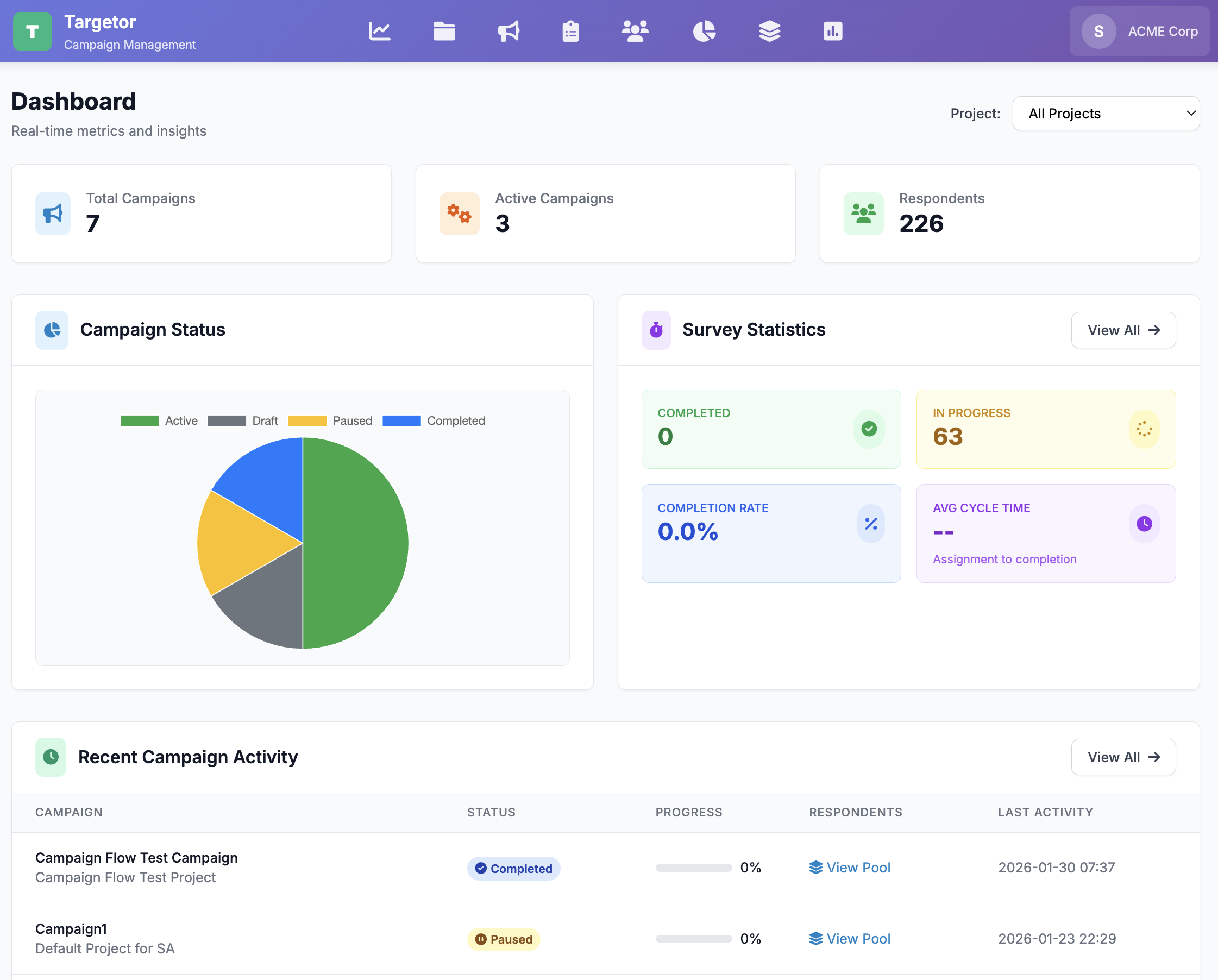
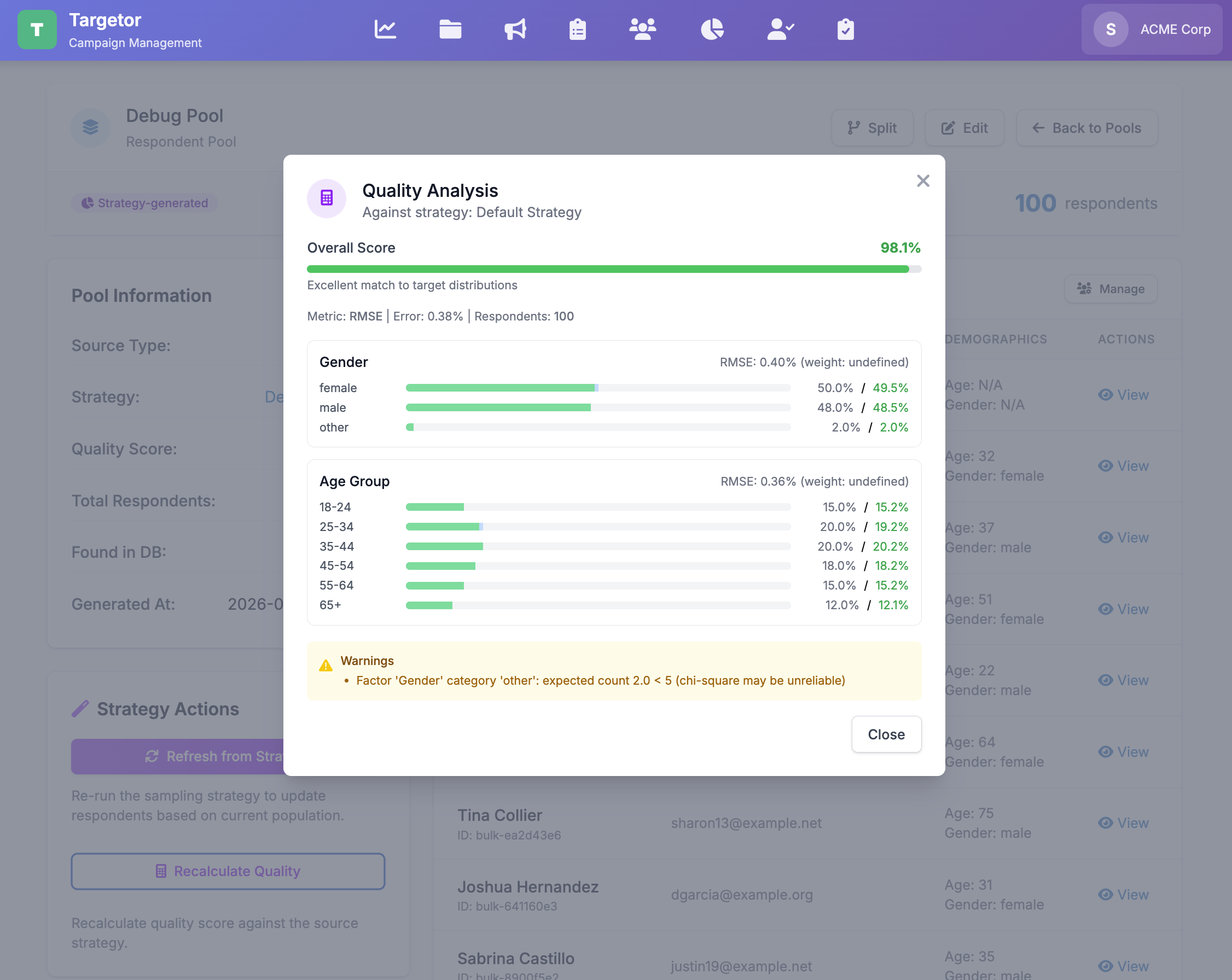
Target the right audience with AI-powered sampling strategies and demographic distribution.
Execute
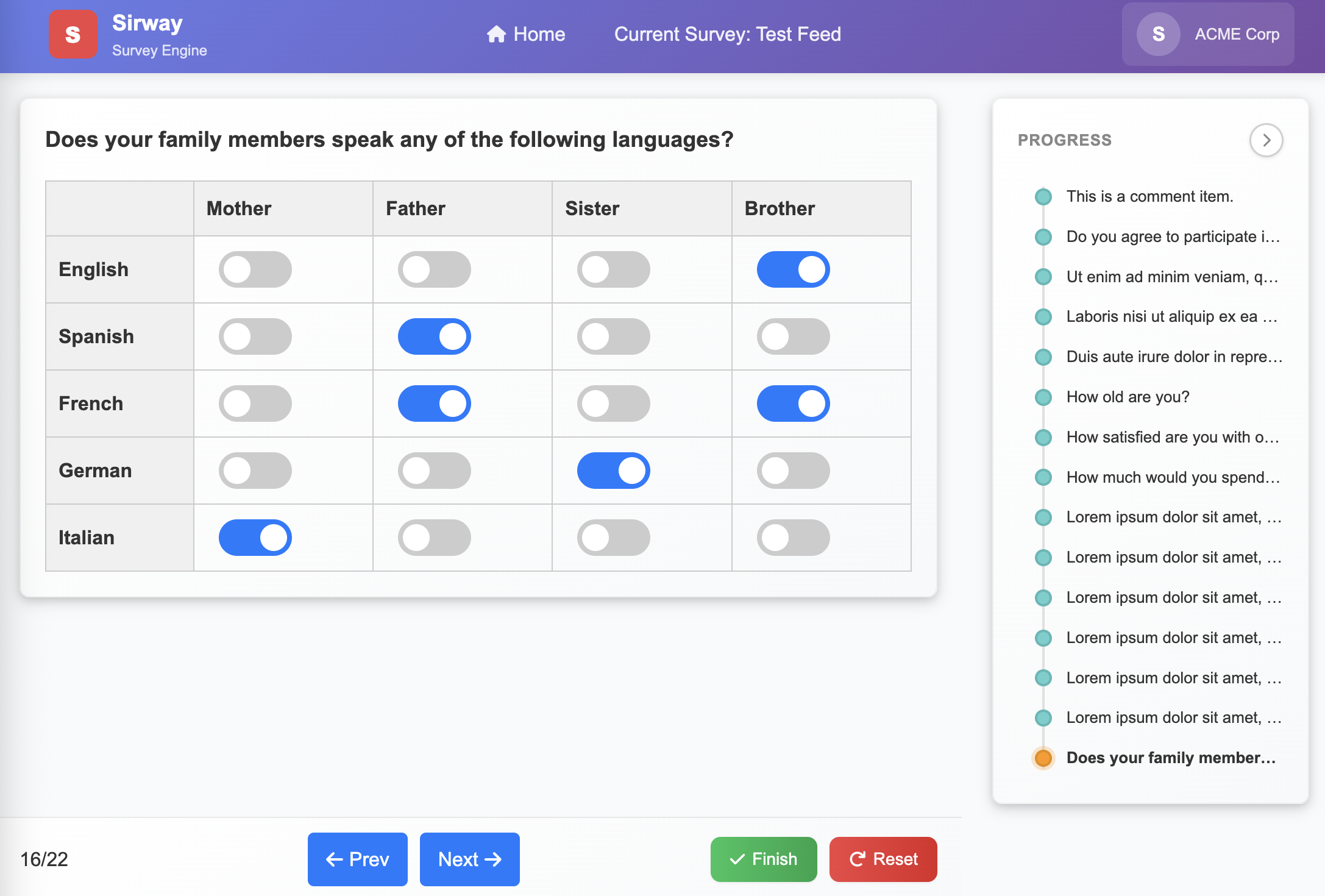
Execute surveys via magic links, interviewer-assisted interviews (phone & in-person), or AI simulation with persona profiles.
Data Quality Analysis
Weight, measure, and defend your dataset — raking, representativeness metrics, straightlining and speeder flags, multi-format export.
A structured Research Brief with traceable citations back to your source documents
Upload your available materials — research papers, regulations, clinical guidelines, policy documents, prior studies. The Research Assistant agent ingests and semantically indexes them, then collaborates with you to define the research goal, measurable metrics, KPIs, target audience, and questionnaire format — all captured in the Research Brief, the source of truth that travels with the project through every stage.
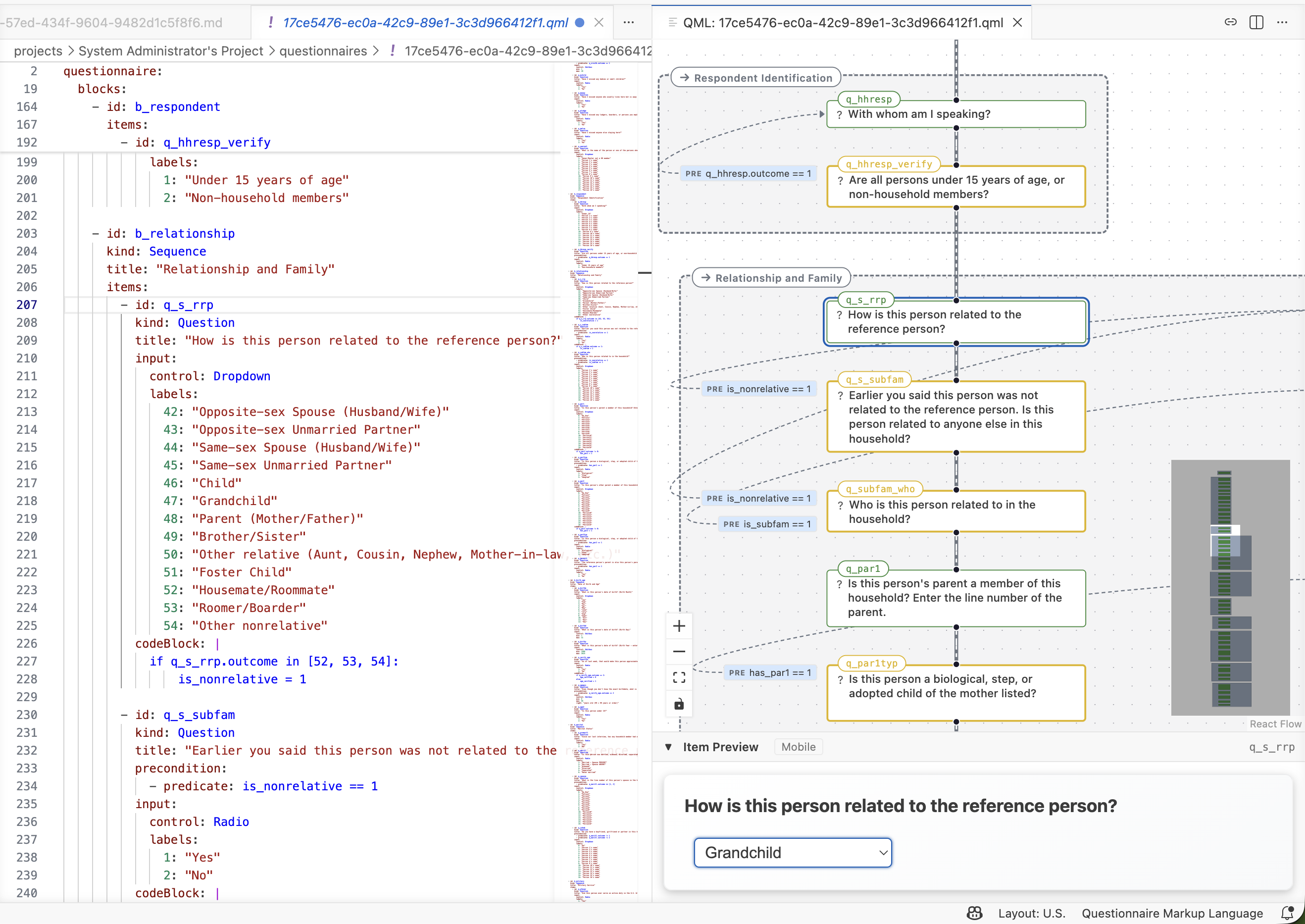
With the Research Brief approved, you or the Designer agent author the questionnaire in QML — conditional logic, skip patterns, and the right response controls. The Z3 SMT solver then mathematically proves there are no circular dependencies, no dead ends, and no contradictions, iterating generate → validate → fix until every path is sound.
Z3 SMT Validation Passed
Every item reachable · all postconditions satisfiable · 0 contradictions
With the Campaign Manager agent, define a sampling strategy, generate respondent pools with quality scoring, and plan the campaign as a single run or recurrent waves. Targetor generates the actual surveys from the campaign and assigns them to interviewers — via a guided wizard, conversational chat, or the 80+ MCP tools.
A guided 5-step wizard — or conversational chat for power users
Monitor & groom — not just this campaign
Track response rates across every running study, refine a campaign mid-flight, and adjust interviewer assignments or respondent pools as the field evolves — recurrent waves keep collecting against the same strategy.
Two execution paths: respondents complete surveys directly via magic links, or interviewers facilitate interviews by phone or in person. SirWay computes each next question lazily from preconditions, so respondents see only what's relevant — and the SMT proof from the design stage guarantees navigation can never contradict itself.
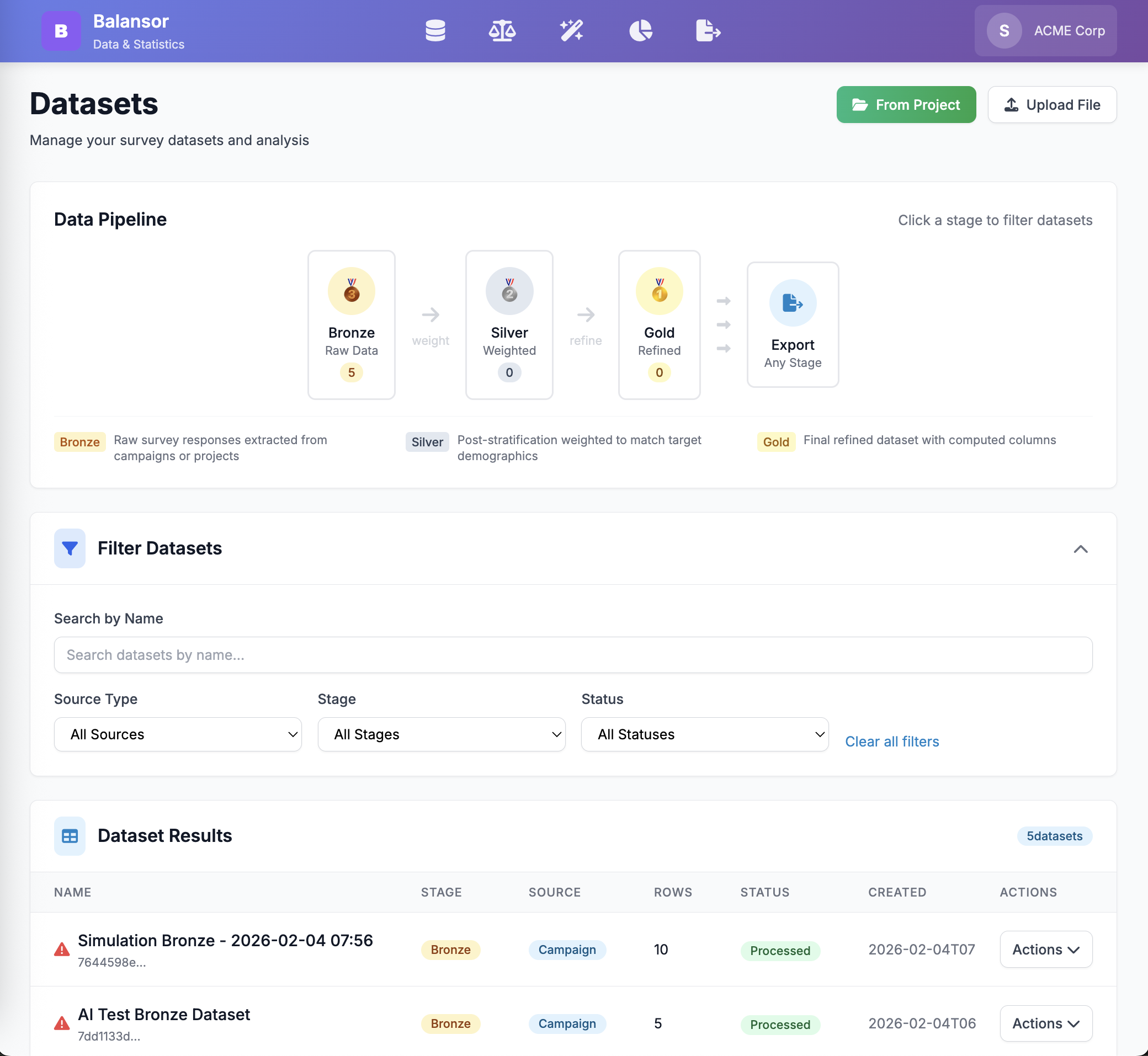
Extract responses from the surveys, QA them, then re-balance with post-stratification raking against the sampling strategy. The medallion architecture refines data (Bronze raw → Silver weighted → Gold publication-ready), and per-stage metrics quantify representativeness, completion, response patterns, and internal consistency. The Analyst agent reads the Research Brief to interpret the dataset against the original objectives, not in isolation.
Open-ended → quantitative
Embeddings group free-text responses by meaning, not keywords, so similar ideas cluster even when worded differently. Choose c-TF-IDF keywords for speed or LLM labels for natural names — each theme becomes a Gold indicator column ready for cross-tabulation and export.
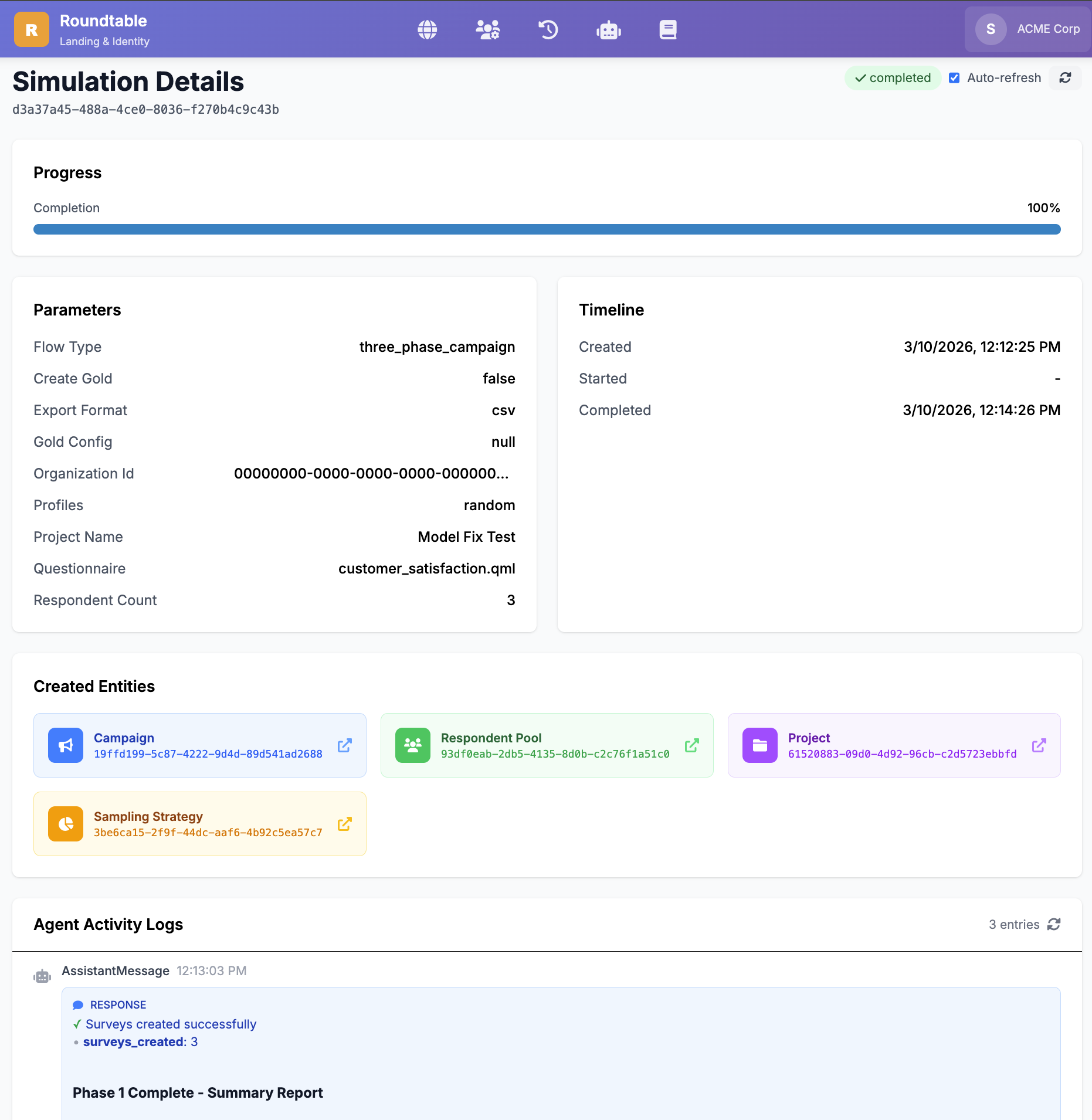
Beyond the five-stage lifecycle, Roundtable can simulate an entire research project with synthetic respondents — for validating questionnaire flow, exercising the analysis pipeline, or generating demo datasets. Response generation has multiple levels: lightweight statistical fills for speed, up to the heaviest mode where each respondent is a unique persona and Claude Haiku answers question by question with the persona, demographics, and accumulated Q&A history — so a respondent who said "unemployed" won't describe a workplace later.
Single
One survey, one persona
Campaign
Full 3-phase lifecycle
Mass Fill
Bulk synthetic data
In the hosted SaaS, our Designer, Manager, and Analyst agents are tuned with the Claude Agent SDK — Anthropic API or AWS Bedrock for IAM, VPC, and data-residency. Prefer your own agentic harness? Connect via MCP and bring any model.
Claude Sonnet, Claude Haiku
Default provider
GPT-4, GPT-4o
Ollama, Llama, Mistral
Free — hosted on our servers
Gemini Pro, Gemini Ultra
When you ask why, our agents don't guess. They consult a shared library of ~30 peer-reviewed books and papers spanning the full research lifecycle — Dillman, Krosnick, Groves, Tourangeau, Bethlehem, Heeringa, Schouten, Fowler — and cite the paper, year, and passage in their answer.
Validity, reliability, wording, skip patterns.
Taherdoost 2016 · Aithal 2020 · Krosnick 2010 · Fagan & Greenberg 1988 · Feeney 2019
Sampling design, weighting, DEFF, adaptive survey design.
Heeringa 2010 · Bethlehem 2012 · Schouten 2009/2013 · Kish 1965
Total Survey Error, nonresponse bias, raking, response quality.
Groves et al. · Bethlehem 2004 · Dillman 2014 · Tourangeau 2000
The library is indexed with graph-aware retrieval so an agent can find the exact passage that answers the question you asked, not just the paper that mentions the topic. Agents default to their built-in training for routine questions to keep latency low, and reach for the full corpus when you ask for a citation or when the question sits outside the routine.
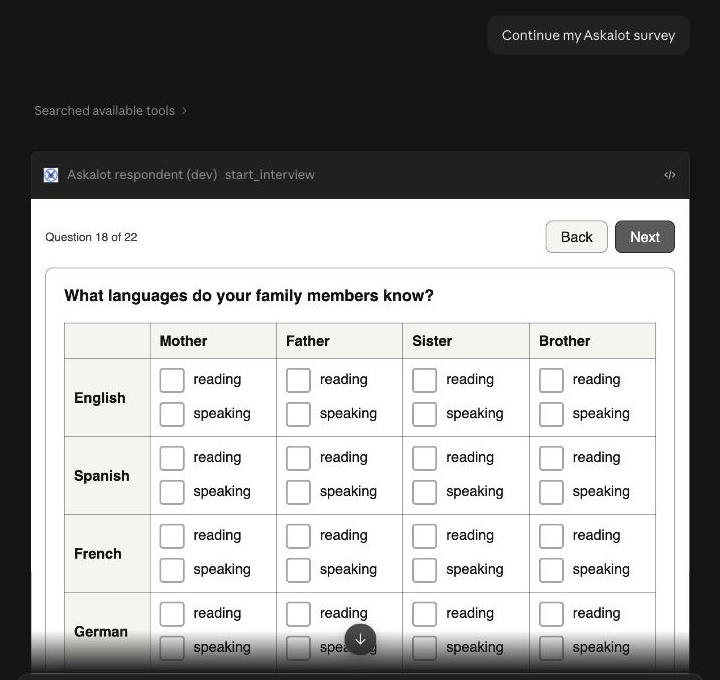
Every platform capability is accessible via REST API and Model Context Protocol (MCP). Drop Askalot into Claude Code, Cursor, Claude Desktop, or your own agentic framework — use whichever model you prefer. The full research lifecycle becomes tool calls for your agent.
// AI agent creates a campaign via MCP
create_campaign({
name: "Q1 National Survey",
project_id: "proj_abc123",
questionnaire_id: "qst_def456"
})
// Then generates a representative sample
generate_pool_from_strategy({
strategy_id: "str_ghi789",
pool_name: "National Sample Q1"
})
Dedicated environments with custom domains, independent databases, and full resource isolation per organization.
Full audit trails, data processing controls, and respondent consent management built into every workflow.
Enterprise-grade security controls with continuous monitoring and formal compliance certification.
Admin, Designer, Manager, Interviewer — granular permissions at project, campaign, and resource level.
Every action tracked with entity history, actor identification, and time-series event storage for compliance.
Agents consult ~30 survey-methodology books and papers across the full research process — Dillman, Krosnick, Groves, Tourangeau, Bethlehem — and cite the passage they used.
Use the hosted SaaS with Claude-tuned agents (Anthropic API or AWS Bedrock), or wire the 80+ MCP tools into your own agent and model of choice.
One Research Brief, four AI agents, formal mathematical proof of every questionnaire's logic — the full research lifecycle in a single platform.